Wednesday, March 2, 2016

Let's Not "Short-Change" Iowa's Most Important Investment

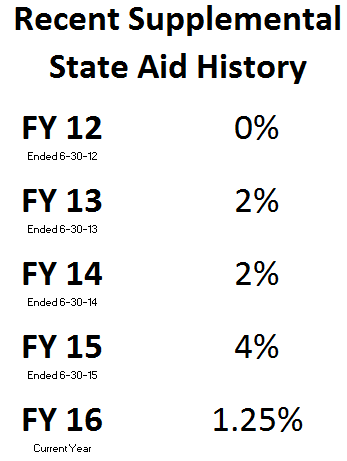
This simple graphic from the Iowa Association of School Boards (IASB) shows the cost per student, per day for each of the current proposals for Supplemental State Aid for schools. Whether the final result is the Iowa House of Representatives proposal of 2%, the Iowa Senate's 4% proposal, the initial 2.45% mentioned by the governor, or something in between, this graphic does a great job of illustrating the relative costs:


If you are a parent, ask yourself this simple question: "Do I expect the cost of raising my child to increase more than $1.43 per day in the coming year?" Even if you are not raising children...do you expect your own cost of living to go up more than $129 to $258 in the coming year?  If your answer is "YES," then consider the cost of educating a child. Just as your family's bills seem to increase each year, a school's cost of operation also keeps increasing. Whether it is the cost of maintaining school buildings and keeping them clean, fueling buses, purchasing instructional materials and supplies, or paying our utility bills, our costs seem to keep increasing.

The largest single cost any school has is the cost of paying the wages and salaries of the teachers and other school staff. Yes, teachers generally receive a raise each year and I would argue that in general they do deserve a raise. Even if school boards and superintendents DIDN'T want to give teachers a raise though, this really isn't possible due to Iowa's collective bargaining laws. When the cost of employing staff keeps increasing and school funding either doesn't increase or doesn't increase enough, schools have few options other than to cut staff.

School districts in Iowa have been cutting, cutting, cutting over the past few years in order to keep their schools operating in times of inadequate state funding, declining enrollment, and increased costs. Schools have become leaner, more efficient, and more creative in their approaches to meeting students' needs. But cutting, efficiency, and creativity will only go so far...we need the leaders of our state to INVEST in our children and INVEST in our future.

Iowa's educators and education supporters aren't "whining" when asking our state's leaders to support our schools. Educators and supporters of Iowa's schools aren't "greedy" when they ask for an increase in funding. Providing a world-class education for Iowa's students isn't free and it isn't cheap. It is an INVESTMENT in our children and the future of our state. Let's not "short-change" Iowa's most important investment.


Wednesday, February 17, 2016

School Funding: Still a Guessing Game


This blog post was submitted for publication in the Friday, February 19 edition of the Traer Star Clipper.

Another deadline has passed without a resolution for Iowa’s schools. Last week was the Iowa Legislature’s self-imposed deadline to resolve the issue of how much general fund financial support to provide for public schools in the coming fiscal year. Long before the legislature convened on January 11th, the governor and legislators from both parties were talking about the importance of following the law this year by setting the level of Supplemental State Aid (SSA) within the first 30 days of the session. The first 30 days of the session have now passed, and an agreement has not been reached on SSA.  Schools across the state have important decisions to make regarding whether to keep or cut programs, services, and staff.

Each April, school boards across the state are required by law to approve a budget for the coming year. Last April, the North Tama board was forced to approve a budget for the coming school year without knowing how much money would be appropriated for their operations. Finally in July, Iowa’s school boards learned that per pupil SSA would increase by 1.25%, and that a large amount of one-time funding that had been approved by the legislature had been vetoed by the governor.


For North Tama, the 1.25% per-student increase in SSA translated into an a $72,000 loss due to our decrease in enrollment, and an additional $53,931 was lost due to the governor’s veto of the one-time funding. This loss of funding has presented significant challenges for North Tama and similar districts. The challenge was made even greater for Iowa’s schools because the news of the veto and Supplemental State Aid didn’t come until the fiscal year had already started, nearly three months after districts were required to pass their budgets.


Remember earlier in this article when I mentioned that the law says the legislature has to set the level of SSA within the first 30 days they are in session? The truth is, I was simplifying my description of that law for those readers who may not read past the first paragraph. If you’ve continued to read this far into my article, you’re ready to hear the whole story about the Iowa law: The SSA they are supposed to be setting is the level for the 2018 fiscal year! That’s right, lawmakers are supposed to set Supplemental State Aid TWO years in advance, so they should have released the rate for the 2018 fiscal year last week.  According to the law, we should have already known the state aid level for next year since LAST FEBRUARY. Now, here we are a year late. We still don’t know, and we don’t know when we will know.  Our budget development may once again be a “guessing game.”  


So what is the budget outlook for North Tama for the coming year?  Since the legislature has made this a guessing game, I suppose we need to look for some clues so we can at least make an educated guess. The Iowa House recently released budget targets that maintain a 2% increase to SSA, while many in the Iowa Senate are promoting 4 percent. Governor Branstad originally proposed a 2.45% increase, but more recently he has said this amount would be a “stretch” due to decreased revenue estimates. If the legislature would happen to complete their session without reaching a compromise, the funding increase would be ZERO percent. Under ANY of these scenarios, North Tama will have another LOSS of funding due to our continued declining enrollment. That’s right...whether our per-student funding increases by 0%, 2%, 2.45%, or even if it increases by 4%, North Tama will experience a DECREASE in funding next year.  


It is our responsibility and our obligation to provide a quality education for all North Tama students. We need to be able to plan strategically as we make important decisions for next year and the coming years. We know that funding will be down even with an increase in state aid due to our loss of students. Difficult choices may need to be made. It would be so helpful to know HOW MUCH funding we will lose next year...and we would know this if the legislature would have simply followed the law in the same way they expect school districts and every citizen to follow the law. Since they haven’t followed the law, the least they can do is end our “guessing game” by working together to reach a compromise on school funding for next year right away. School districts must live by the rules. We need the Iowa Legislature to do the same.

For information on how to contact Senator Steve Sodders, who represents the entire North Tama district in the Iowa Senate, click here. (Includes email, postal address, and telephone.)  


For information on how to contact Representative Dean Fisher, who represents the entire North Tama district in the Iowa House of Representatives, click here.  (Includes email, postal address, and telephone.)  


For information on how to contact the office of Governor Terry Branstad, click here. (Includes postal address, telephone, and a way to register your opinion online.)  

Tuesday, December 29, 2015

North Tama Needs Your Help - Please Advocate for Our School!


This blog post was submitted for publication in the Friday, January 1 edition of the Traer Star Clipper.

The 2016 Iowa Legislature will convene on January 11, 2016. The last legislative session was not good for education in Iowa, so our advocacy is more important now than ever before. Legislators often hear from school superintendents, administrators, teachers, and school board members. After a while, it seems that they get tired of hearing from those of us in the educational community. The legislature needs to hear from parents, community members, and local business owners that our schools are valued and a vital part of our communities! I was recently told by one former legislator that an advocacy phone call or letter from a parent or community member is more highly regarded than 10 advocacy calls from school superintendents.  

Perhaps in the news last summer you heard the story about a Waterloo teacher who was told by a legislator to “stop whining” when he advocated for a special legislative session to overturn the Governor's veto of one-time funding for schools. While I don’t appreciate this legislator’s response, it does make sense that some legislators will perceive advocacy from educators as self-serving rather than an effort to help our students. Because of this, and the fact that our efforts were not very successful  last year, it is evident that we need your help. If we can get parents and community members involved in our advocacy efforts, I think you can help make a huge difference for North Tama Schools. Here is what I believe are the highest priorities for this legislative session.

ADEQUATE SUPPLEMENTAL STATE AID (SSA): This is absolutely the highest-priority item. Supplemental state aid is the primary driver of funding for school districts’ general budgets. Last year, school districts received a 1.25% increase in SSA. Since this increase is on a PER-STUDENT basis, districts with declining enrollment like North Tama actually LOST money. Meanwhile, our costs have increased more than 1.25% even despite the cuts that were made. A situation like this will not be sustainable in the long term. Adequate SSA will be a key factor in keeping schools like North Tama viable in the long term.  

TIMELY SUPPLEMENTAL STATE AID (SSA): According to Iowa law, within the first 30 days of the legislative session each January the legislature is supposed to set the rate of school funding for the next TWO fiscal years. The Iowa legislature broke this law last year, and has done the same numerous times over the last several years. North Tama’s board was required by law to adopt a budget last spring, even though they didn’t know what the funding levels would be at the time. Schools need to be able to plan ahead in order to be fiscally responsible. Let’s ask our legislature to comply with the law and set the rate of school funding for the next TWO fiscal years.  

PER-STUDENT FUNDING EQUITY: Iowa’s school funding formula has built-in inequities that impact school districts and the students they serve. Since, the 1970’s when the current school funding formula was established, North Tama has received the LOWEST amount of per-student funding possible from the state of Iowa. While we do receive the exact same funding per-student as many districts in the state, just look at what some area districts have received, year after year, since the 1970’s:

Hudson: $175 more per student than North Tama
Union: $82 more per student than North Tama
BCL-UW: $81 more per student than North Tama
Cedar Falls: $7 more per student than North Tama
South Tama: $20 more per student than North Tama

Across the state, there is a $175 range in basic per-student funding that exists just because “it has always been that way.” This means North Tama and many other districts have less to invest in each student from day one. Please ask the legislature to end this inequity immediately, as ALL of Iowa’s students are important assets for our future!

TRANSPORTATION EQUITY: Districts that must spend more on transportation have less to spend on classroom instruction. There are districts in Iowa such as West Burlington (Total Land Area: 2 Square Miles) and Marion (Total Land Area: 3.6 Square Miles) that have very few students that even qualify daily for bussing because they live so close to the school. These districts spend virtually nothing on transportation compared to larger rural districts like North Tama (Total Land Area: 155 Square Miles). North Tama’s students deserve equal educational opportunities, yet districts like ours are forced to spend a higher percentage of our available funds on transportation leaving less money to provide these opportunities. Our legislature should be asked to provide an additional funding stream for transportation or use a formula based on population density when determining Supplemental State Aid.

If you would like to learn more about these or any other advocacy issues that are important to North Tama Schools, please feel free to contact me! Your help and advocacy will be critical during the upcoming legislative session. On my blog, I have posted contact information for our legislators and the Governor’s office so you can easily make contacts on our behalf. You are welcome to visit my blog at http://redhawksupt.blogspot.com/ where this column and all of the columns I have written for the Star Clipper are posted. You are also welcome to follow me on Twitter (@DavidRobertHill) where I will occasionally post updates or other information not found on the blog. THANK YOU for your support of the North Tama County Community School District!


For information on how to contact Senator Steve Sodders, who represents the entire North Tama district in the Iowa Senate, click here. (Includes email, postal address, and telephone.)  


For information on how to contact Representative Dean Fisher, who represents the entire North Tama district in the Iowa House of Representatives, click here.  (Includes email, postal address, and telephone.)  


For information on how to contact the office of Governor Terry Branstad, click here. (Includes postal address, telephone, and a way to register your opinion online.)  


Monday, December 7, 2015

Keep Your School & Community Strong - Do Business Locally!!!


This blog post was submitted for publication in the Friday, December 11 edition of the Traer Star Clipper.

Several of my recent columns have focused on issues related to school finance and the challenges we are facing at North Tama because of declining enrollment, decreased flexibility in funds available, and lack of adequate funding.  I have asked for the community’s support by contacting your legislators and the governor’s office to request adequate general fund resources for schools. In today’s column, I’ll discuss something else that every one of us can do to help keep our school and our community strong.
A community that has a variety of thriving businesses is a more attractive place to live. Many people prefer to live in a community where they have easy access to various entertainment options, access to the services they need, and the opportunity to purchase necessary items such as groceries, clothing, and hardware without having to drive a long distance. When you choose to do business locally rather than spending your dollars outside of the school district, you help to make your community stronger by keeping your dollars local and by helping to keep those businesses open. A thriving business community results in greater job opportunities and makes the community a more attractive one in which to live, which could result in increased population and greater enrollment in the local schools.  
The Christmas shopping season is now in full swing. This is a great time to think about doing more of your business right here in the communities of the North Tama school district. Shopping locally doesn’t need to be confined to a particular “season” though -- your community can benefit from your support year-round, and you will personally benefit, too.  
The North Tama County Community School District is so fortunate to have a multitude of options for doing business locally! Right here in the communities of the North Tama school district there are great businesses where you can purchase hardware, groceries, apparel, furniture, agricultural supplies, lawn mowers, pharmaceuticals and personal care items, tires and auto parts, specialty items such as floral arrangements and quilting supplies, and much more.
There are numerous great local options for banking, lodging, insurance, medical and dental services, accountants, photographers, realtors, legal services, auctioneering, agricultural services, plumbing and electrical contractors, veterinary services, beautician/barber services, construction services, and automotive services. Other local services in Traer and Clutier include an amazing small-town theater, great local libraries, three museums, a country club, swimming pool, fitness center, and more. There are also some wonderful dining options in Traer and Clutier, so consider spending your next night “out-on-the-town” in your own community rather than driving to Waterloo or Cedar Falls.
Here are some reasons why you should consider doing business locally whenever possible:
  1. Better customer service. When you run into a problem, you’re more likely to receive a satisfactory resolution from a local business owner than from a big-box chain. That’s because you probably know the people in charge at a local store.
  2. Stimulation of the local economy. When you shop at locally owned stores, the money you spend stays in the community. And local businesses are more likely to purchase from other local businesses, so the local tax base grows and so do local businesses. A stronger tax base means improved schools, better roads and greater support for local police and fire departments.
  3. Job creation. Small businesses are big employers. With jobs being created where you live, your friends, neighbors and family can find jobs closer to home. That has a huge impact on family, community and the environment because it keeps money in the community (see No. 1) and cuts back on commutes. It may also result in increased enrollment for your local school district.
  4. Better consumer choices. The more choices you have, the better the deals you can find. Small businesses encourage competition in the marketplace in a way that mega-corporations just can’t. Many people don’t shop locally because they think they can’t buy the things they need in a local store. Not true! Small business owners are more than willing to carry and stock special items.
  5. Greater non-profit support. Local businesses tend to donate more to local schools and non-profit organizations. This directly benefits your friends, family and neighbors.
  6. Your bottom line. Because local businesses help grow the economic base of the community, the dollars you spend have the ripple effect. That money will eventually find its way back to you.
You don’t have to shop locally every time to make an impact. Just getting in the mindset of doing business locally first is all it takes to start improving your community and your school.
I hope you have enjoyed the columns that I have submitted to the Star Clipper over the past several months. These columns as well as my blog and Twitter postings are part of my plan for open communication with the community. As a part-time superintendent that also has duties in another school district, I believe that open and clear communication is more important than ever before. If you’ve missed any of my columns or would like to re-read or share them with your friends and family, you are welcome to visit my blog at http://redhawksupt.blogspot.com/ where they are all posted. You are also welcome to follow me on Twitter (@DavidRobertHill) where I will occasionally post updates or other information not found on the blog. Have a Merry Christmas!

Tuesday, November 24, 2015

North Tama in the News


North Tama is producing some great results, within and beyond our classrooms! The accomplishments of several Redhawk alumni, faculty, and family members have been featured in the news media recently. In today's blog post, I'll share links to the recent media coverage showing off the talents and accomplishments of several members of the North Tama educational family.
NT alumnus Nikki (Wagner) Hynek


North Tama alumnus Nikki (Wagner) Hynek was recently featured in this article in The Gazette focusing on her entrepreneurial spirit and the cosmetics company she recently founded: Dollup Beauty Looking Good


Alumnus Jeff Morrison with Bruce Morrison

  
The Gazette also featured an article focusing on Bruce Morrison (husband of teacher Judy Morrison) and his retirement from farming, as well as a look at the changes in the farming industry Bruce has witnessed over the years. The article was written by North Tama alum Jeff Morrison: Dramatic change on the family farm in a single generation


North Tama's High School Agricultural Education Teacher and FFA Advisor, Mr. Matt Cibula, is also a successful purebred Gelbvieh cattle producer along with his wife Tina. They were recently featured in this article in the Iowa Farmer Today magazine: Producer preps by adding windbreaks, watching feed.  It's great to have a leader in the cattle industry serving as the leader of our North Tama Agricultural Education program!

You may have heard that North Tama was recently selected by the Governor's STEM Advisory Council as a recipient of the Iowa STEM Redesigned Learning Environment (RLE) grant, which will allow our elementary to redesign one of our classrooms into a learning space that is custom-tailored for integrated STEM and Literacy instruction. As a classroom that will focus on early childhood STEM and Literacy Integration, this will be a first-of-its-kind classroom in the state of Iowa. We've received media coverage in a number of places as a recipient of this grant, and more media attention is sure to follow.  Check out the links below:

L to R: Jeff Beneke, NE Iowa Regional STEM Hub Manager, Lisa Chizek, 
NT 5th & 6th Grade Teacher & STEM Coordinator, Dr. Beth Van Meeteren, 
UNI Regents Center for Early Ed, Vonna Watson, NT 1st Grade Teacher,
David Hill, NT Superintendent, and Josh Youel, NT Elementary Principal.
  • While this story from KCRG-TV9 features the proposed grant project in the Charles City district, the North Tama project is mentioned: Four-district partnership, 11 others awarded state STEM grants. KCRG has expressed an interest in coming to North Tama this spring to do a feature story on our new STEM classroom. 


The effort to apply for this grant was led by Lisa Chizek and Vonna Watson. Congrats to Lisa, Vonna, and all of the North Tama Elementary staff!

We're proud of the staff, students, and alumni at North Tama. Watch the news in the weeks, months, and years to come...we're bound to see more great results coming from our classrooms, our programs, our graduates, and our faculty!


Tuesday, November 17, 2015

Governor Backs Down on Previous School Funding Proposal


North Tama District Patrons, 
I wanted to share this article from yesterday's Des Moines Register with you. The article gives us a "sneak peek" into what the governor is thinking with regard to Supplemental State Aid (SSA) for the coming budget year. Governor Branstad said yesterday that he is required by law to look at December’s revenue estimates before he can recommend any funding levels. It's funny how our state government intends to follow THAT law, but not the one requiring them to approve the level of funding a year in advance, allowing districts to plan ahead. The governor had previously said that he'd like to see SSA set at about 2.45% for this coming year, but now he's saying that he can't commit to that right now.    

The Governor said, “I have to wait until we have the December revenue estimate to base my budget...It’s my hope that we can do (2.45 percent), but it’s going to be a little more difficult that the October revenue estimate was reduced by $125 million.
My best guess...the governor will end up recommending somewhere between 1.25 and 1.75% SSA, and after a great deal of politcal wrangling, we'll end up with somewhere in between 1.25 and 2%. This is simply not enough to keep up with the rising costs that school districts are facing, especially considering the fact that schools have been "shorted" for several years. Schools are very likely to end up with 1.25 to 2% unless MANY, MANY Iowans contact their legislators to express how upset they are that schools have been shortchanged repeatedly over the past five years. I strongly urge you to get involved and to advocate for Iowa schools
The full Des Moines Register article can be viewed here: 

Thursday, November 12, 2015

Strings Attached - Categorical Funding in Schools


This blog post was submitted for publication in the Friday, November 13 edition of the Traer Star Clipper.

In my column two weeks ago, I explained that North Tama’s certified enrollment is down by 39 students this fall compared to a year ago, and that our enrollment has decreased by about 100 students over the past six years. While our school district’s current financial position is still good, I am very concerned about the long-term implications for North Tama if the trends of declining enrollment and inadequate state funding don’t change.

In this week’s column, I’d like to explain why a school district like North Tama is able to pay for a major facility renovation project -- such as the recent new restroom building at the softball/baseball complex or the remodeling of our secondary office -- while being forced to reduce staff, share administrators, or take other cost-saving measures. It comes down to the way schools are funded in the state of Iowa. A large percentage of the money schools receive is considered categorical funding.

Categorical funding is financial support that is targeted for particular categories of students, certain special programs, or other very specific purposes. North Tama receives categorical funds in areas such as capital projects, dropout prevention, at-risk programs, special
education, core curriculum implementation, talented and gifted programs, professional development, teacher quality, and early literacy to name a few. School districts accept this money with STRINGS ATTACHED, meaning we are obligated to spend the funds exclusively as directed by the state or federal government, or the agency granting the funds. The funds that were recently spent on the new construction at the athletic complex and the remodeling at the high school came from the capital projects fund which can ONLY be spent on projects like this. Spending this money on salaries, supplies, utility bills, or other general expenses would be illegal.

While it is great to have a source of funding for construction and for other special programs and projects, the allowable uses of these funds is quite restrictive, and these funds do nothing to help us pay the general bills such as utilities and salaries. More than 80% of most school district’s budgets is taken up with these types of general expenses. Adequate funding or lack of adequate funding to pay these general expenses is the main factor in whether a school is able to maintain its long-term viability. The problem is for many schools is that the state continues to trend toward providing more categorical funding streams while providing fewer general fund dollars. To keep the school’s doors open, adequate support for our general fund is a necessity.

In a press conference on August 3, Governor Branstad spoke about his desire to continue the practice of earmarking funds for specific programs. Specifically, he stated, “It’s not like the old days -- you don’t just ‘throw money’ at schools...We want to become best in America again and I think that’s going to take specific and strategic investments in education that focus on things that really make a difference.” His strategy is to shift from providing general fund dollars to providing more categorical funding that is focused on specific programs that he believes will improve student achievement.

While I agree that many of these programs are great and will truly make a difference for our students, I think we also need to understand that when categorical funding is provided at the expense of general funding many of our smaller rural school districts will be forced to cut teachers and support staff, and may eventually need to close their school buildings or merge with another district. Is this really what is best for students?  

The North Tama School Board’s number one goal is to maintain the financial stability of the district and retain existing programs so that North Tama will remain a viable K-12 school. Declining enrollment and decreased flexibility in funding due to the shift from general funding to categorical funding will make it even more difficult for us to achieve this goal. To make this goal a reality, we will need to be intelligent and intentional with our resources and will need to take further measures to cut costs during the coming months and years.

The 2016 legislative session is just 8 weeks away. Please consider contacting your legislators and the governor's office to let them know that it is critical for them to provide adequate GENERAL FUND support for our schools. Our legislators need to realize that many smaller schools are struggling to keep the doors open due to declining enrollment and unreliable, inadequate funding. By providing adequate supplemental state aid WITHOUT STRINGS ATTACHED, local school boards can have the flexibility to set priorities and continue providing a quality education for our students. The students in our smaller schools deserve the same opportunity as students in larger urban and suburban schools. These students represent the future of our state, and they deserve nothing less.  

You are welcome to visit my blog at http://redhawksupt.blogspot.com/ where you can read all of my Star Clipper columns and leave comments if you wish. You are also welcome to follow me on Twitter, where my handle is @DavidRobertHill.